
Why short games work well as quick breaks
November 9, 2026
By Ace Jones, ATech Software
A good break has an ending. That sounds obvious until you notice how many pauses do not: you open a feed “for a minute,” and the minute dissolves.
Short arcade games get mentioned in that conversation because a round can be complete in less time than a video, and because the rules are obvious. The research on breaks is more careful than a slogan, and it does not say that playing games will make you more productive, healthier, or better at your job. What it does support is smaller than that, and still useful: brief pauses from work are linked with feeling more vigorous and less fatigued, and a game with a natural stopping point can be one way to keep a pause from turning into an open tab you never close.
Meta Birds is a free playable prototype you can try on the home page. It is made by ATech Software and independently developed by Ace Jones, ATech Software. It is not endorsed, sponsored, or developed by Meta Platforms, Inc., Ray-Ban, or EssilorLuxottica. The live how-to is short: flap and maintain altitude, and don’t hit the pipes. See How to Play.
What a micro-break is, in the studies
In 2022, Patricia Albulescu and colleagues published a systematic review and meta-analysis in PLOS ONE titled “Give me a break!” They looked at experimental and quasi-experimental studies of micro-breaks, which they defined as short discontinuities in a task of no longer than 10 minutes.
They found 19 records, which produced 22 independent samples and a total of 2,335 participants. Using random-effects meta-analysis, they reported statistically significant but small effects of micro-breaks on vigor (d = 0.36) and on reducing fatigue (d = 0.35). The effect on overall performance was not statistically significant (d = 0.16).
Two nuances matter if you are tempted to over-read that.
First, performance was not a wash in every subgroup. The authors reported that benefits for performance showed up more clearly on less cognitively demanding tasks (they mention creative and clerical work) and that longer breaks inside that under-10-minute window were associated with a larger performance boost. They suggested that recovering from highly depleting cognitive tasks may take more than a 10-minute pause.
Second, the review is about taking a short break from a task. It is not a review of video games, smart glasses, or tap-to-fly scores. Some of the underlying studies used all sorts of pause activities. The honest takeaway is: stepping away for a few minutes tends to help how people feel; it is not a proven shortcut to better work on a hard thinking task, and it is not proof that any particular hobby is medicinal.
What this does not mean about games
It does not mean you should play until you beat a personal record.
It does not mean a game is better for you than a walk, a glass of water, or looking out a window. The American Optometric Association’s advice for digital eye strain is to look away from near work: every 20 minutes, view something 20 feet away for 20 seconds, and consider a longer rest after two hours of continuous screen use. A game on a phone, a laptop, or a heads-up display is still near work. It does not replace that look into the distance.
It does not mean performance will rise because you opened Meta Birds. The meta-analysis did not find a significant overall performance effect, and it certainly did not test this playable prototype.
If you wear Meta Ray-Ban Display glasses, it also does not cancel Meta’s safety guide. Sit down. Do not play in traffic, on stairs, or while driving or cycling. Stop if you feel discomfort. Those rules are in Comfort and safety when gaming on smart glasses.
Why a short game can still be a useful shape for a pause
The useful idea is not “games restore you.” The useful idea is “some activities end.”
A one-button or tap-to-fly round has a beginning, a middle, and a clear finish: you flap and maintain altitude, you don’t hit the pipes, and then the attempt is over. You do not have to invent a stopping rule the way you do with an infinite scroll. That design is part of why one-input games spread on phones in the first place, a history sketched in A short history of one-button arcade games.
If you decide to use a short game as the activity inside a micro-break, treat the game as the timer:
- Choose a fixed number of attempts — three, or five — before you start.
- Sit down, especially if you are on smart glasses.
- Play those attempts only.
- Close the page or look away from the display.
- Spend at least 20 seconds on something farther away than the screen, following the AOA’s distance reminder.
- Go back to what you were doing.
The bound is the point. “Just one more try” is how a five-minute pause becomes twenty. Tips for playing more calmly, rather than more obsessively, are in How to last longer in tap-to-fly games.
A note on “always-on” work
Albulescu and colleagues framed their review against an always-on culture and the idea that recovery also happens in short intervals during the day, not only in evenings and vacations. Their discussion supports encouraging short breaks as a well-being practice, while being cautious about promising a performance dividend on demanding cognitive work.
That is a workplace finding, not a prescription to install an arcade next to every spreadsheet. If a short playable prototype helps you actually stand up from a task for a few minutes — and then return — it is doing the job of a timer. If it keeps you hunched over a display, it is just more screen time with a bird in it.
Meta Birds is built for short sessions you can open in a browser with no download, or load on Meta Ray-Ban Display glasses as a web app. That convenience cuts both ways. It is easy to start, which is why the ending has to be a decision you make in advance.
When you want the pause, open the home page, take the attempts you promised yourself, then look up. The pipes will wait.
Related reading
- Comfort and safety when gaming on smart glasses
- How to last longer in tap-to-fly games
- What a playable prototype means
- How to Play
- About Meta Birds
- Dev Blog
- Play on the home page
Sources
- Albulescu, P., Macsinga, I., Rusu, A., Sulea, C., Bodnaru, A., & Tulbure, B. T. (2022). “Give me a break!” A systematic review and meta-analysis on the efficacy of micro-breaks for increasing well-being and performance. PLOS ONE 17(8): e0272460. https://doi.org/10.1371/journal.pone.0272460
- American Optometric Association, “Computer vision syndrome,” https://www.aoa.org/healthy-eyes/eye-and-vision-conditions/computer-vision-syndrome
- Meta, “Health And Safety Warnings | Meta Ray-Ban Display,” https://www.meta.com/legal/ai-glasses/health-and-safety-warnings/meta-ray-ban-display/
- Live Meta Birds homepage, https://meta-birds.com/, fetched November 9, 2026
Sources checked November 9, 2026 (America/Chicago).
Learn the game
Related Articles
Nov 9, 2026
If Meta Birds will not load, try these checks first
If Meta Birds will not load, check the desktop browser, itch.io on a phone, or the glasses web-app steps before assuming it is broken.
Nov 9, 2026
What “playable prototype” means for Meta Birds
Meta Birds is a playable prototype: you can try it now in a browser or on Meta Ray-Ban Display glasses, and it is not a finished store release.
Nov 9, 2026
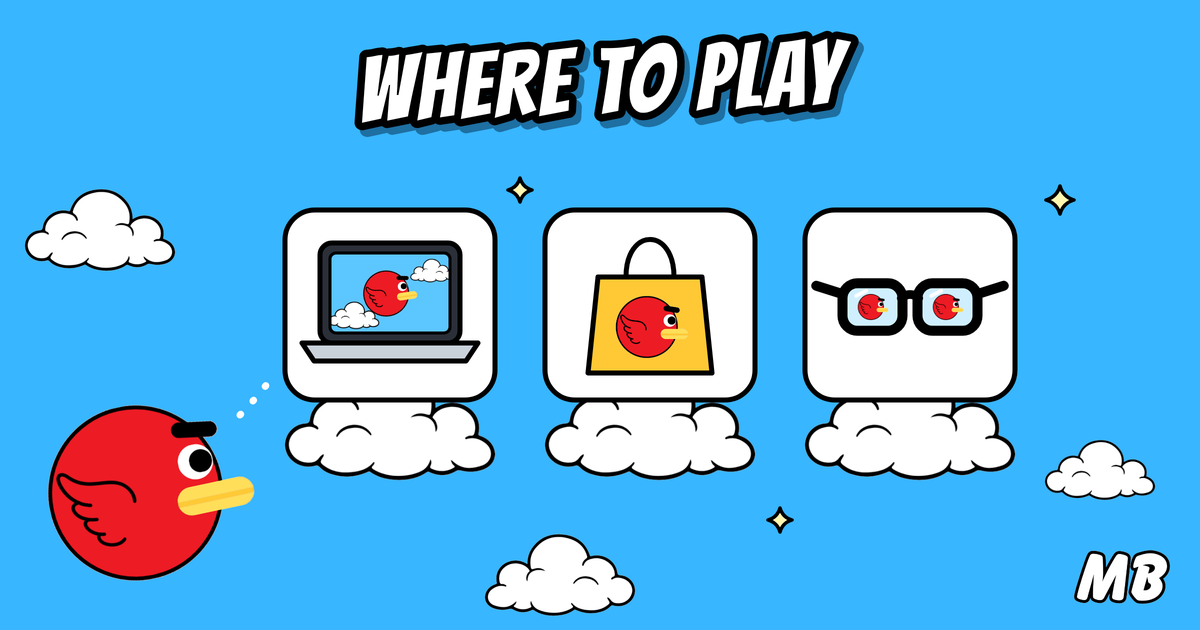
Where to play Meta Birds: browser, itch.io, or glasses
Try Meta Birds in a desktop browser, on itch.io if you are on a phone, or as a web app on Meta Ray-Ban Display glasses.